Homun is one of those Yucatan towns that still hasn't made it onto the big tour operators' itineraries, and that's exactly what makes it worth your time. Forty-five minutes from Merida, this municipality of just over 8,000 people sits on something few places on earth can claim: more than 20 freshwater cenotes open to the public, all connected underground by the same aquifer.
But Homun is more than cenotes. It's cochinita pibil cooked in an underground pit since 4 in the morning, 17th-century henequen haciendas standing in beautiful ruin, Yucatec Maya spoken in the town market, and the unguarded friendliness of the people who live here.
1. The cenotes — the main reason to come
There's no talking about Homun without talking about its cenotes. The town sits directly on the Yucatan cenote ring, a circular formation of freshwater sinkholes that traces the rim of the Chicxulub crater — the meteorite impact that ended the dinosaurs 66 million years ago.
The result is a concentration of cenotes unlike anywhere else on the planet: more than 20 open to visitors within about 3 miles. Some are fully underground and pitch dark, hung with ancient stalactites. Others are semi-open, where light enters in dramatic shafts. A few are wide open, holding an emerald green that no Instagram photo quite captures.
Unlike Yucatan's famous cenotes — Ik Kil, Dos Ojos, Cenote Azul — Homun doesn't get mass tourism. Here you can swim in silence, hearing only water dripping from the stalactites, without the soundtrack of 200 people taking selfies.
The cenotes worth prioritizing
- Cenote Santa Bárbara — The most complete. Four different cenotes in one park: Cascabel (underground), Chacsinkín (semi-open), Xooch' (open) and Pool Cocom (open, crystal clear). Full facilities with a restaurant, changing rooms and a small train between cenotes. The family favorite, and one of very few cenotes in Mexico with an elevator for visitors with limited mobility. From $35 USD.
- Cenote Santa Rosa — The least known and, according to many visitors, the most authentic. Deep emerald water and almost no crowds. From $19 USD.
- Santa Cruz Cenotes — A colonial hacienda paired with a turquoise underground cenote, plus a zip-line and a suspension bridge. From $36 USD.
2. Henequen haciendas
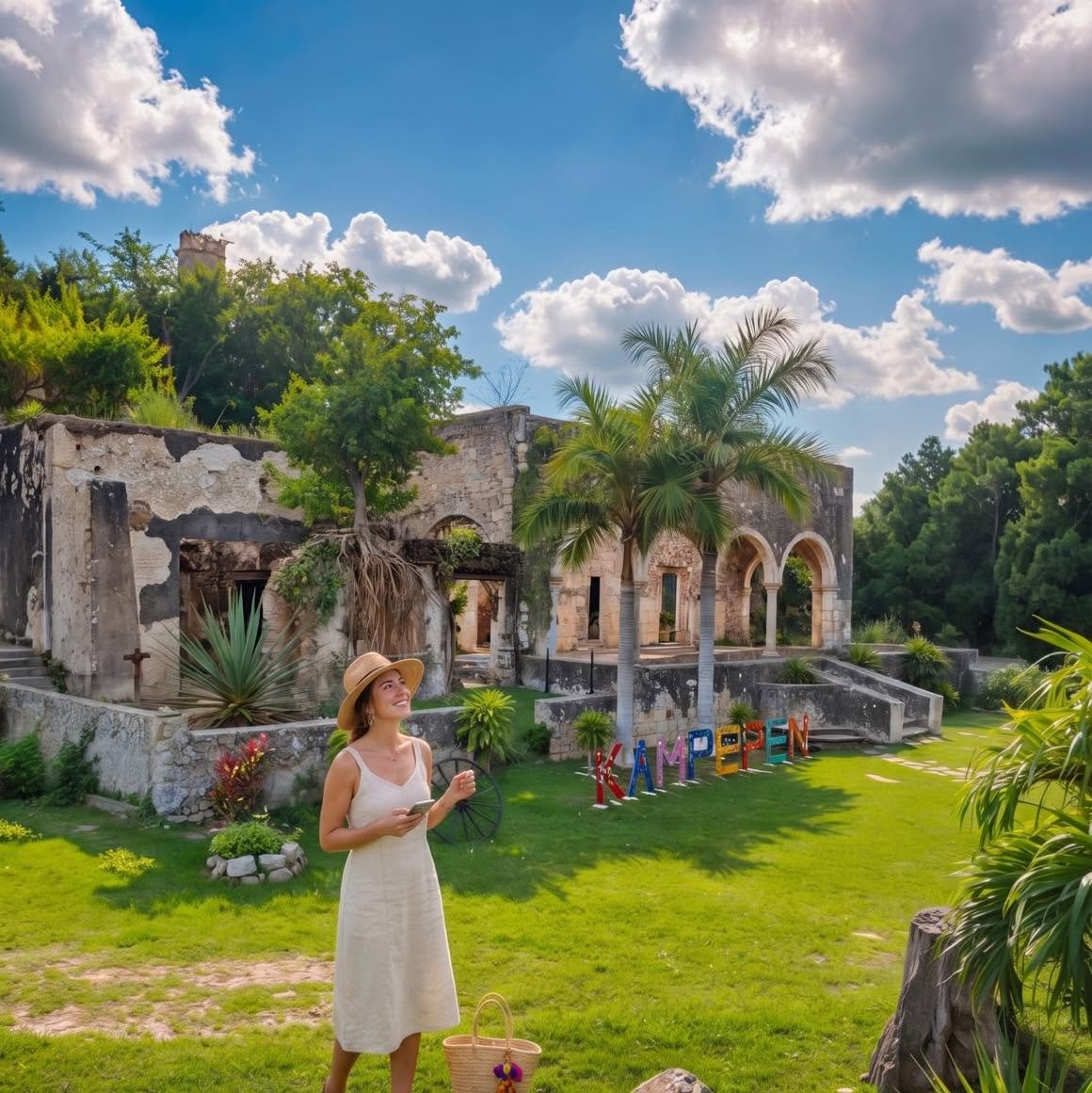
In the 19th century Yucatan ran on henequen — the agave fiber known as "green gold" that made Merida, for a time, one of the wealthiest cities in the Americas. Homun and the surrounding towns are dotted with the haciendas from that era, most now standing in atmospheric ruin.
The chimneys, machine houses and arched entrances make for some of the best photography in the region, and they tell you more about how Yucatan actually became what it is than any museum. Hacienda Kampepén, on the Santa Cruz property, is the easiest to visit as part of a cenote tour.
3. Maya food
Homun eats well and cheaply. The dish to plan around is cochinita pibil — pork marinated in achiote and sour orange, wrapped in banana leaves and buried in a pit oven overnight. In Homun it goes in around 4 AM and comes out mid-morning, which means the best of it is gone by early afternoon. Eat it for breakfast or an early lunch, not dinner.
Also worth trying: sopa de lima (turkey and lime soup), panuchos and salbutes from the stands around the central park, and cold agua de chaya, made from a local leafy green. Expect to pay $3–6 USD for a full meal.
4. Crafts and local culture
Yucatec Maya is still spoken daily in Homun, especially in the market and among older residents. It's not a performance for tourists — it's the working language of the town.
Local artisans work with henequen fiber, making hammocks, bags and rope by hand. A well-made Yucatecan hammock is one of the few souvenirs from this region genuinely worth carrying home, and buying directly in a town like Homun means the money goes to the person who made it.
A suggested day in Homun
- 8:00 AM — Leave Merida (about an hour by car or colectivo)
- 9:00 AM — First cenote, while the light is good and the water is empty
- 11:00 AM — Second cenote, ideally a different type than the first
- 1:00 PM — Cochinita pibil in the village
- 2:30 PM — Hacienda ruins or a third cenote
- 4:30 PM — Head back to Merida
Swimsuit worn under your clothes, towel, water shoes (the stairs get slippery), biodegradable sunscreen only — regular sunscreen is banned in cenotes to protect the water — and cash in pesos. There's no reliable ATM in town.
Want a local guide for the day?
We run small-group tours in Homun with bilingual guides who grew up here. Entry fees and gear included, pay cash on arrival.