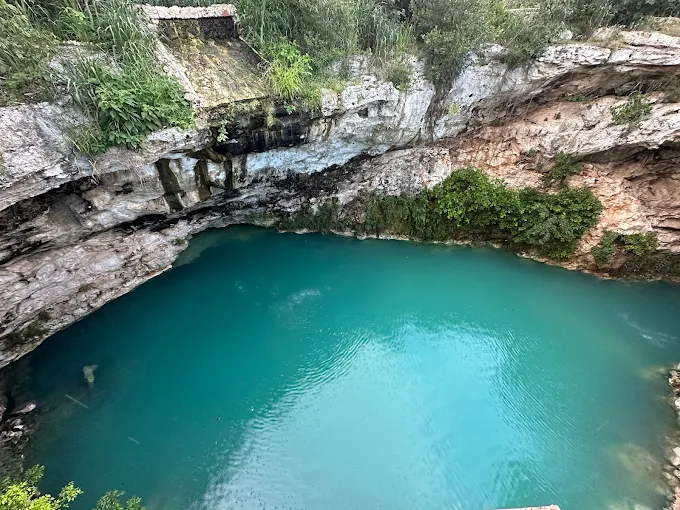
Merida is one of the best bases for exploring Mexico. From the White City you can reach — in under two hours — freshwater cenotes found nowhere else on earth, the most imposing pyramids the Maya built, colonial towns painted canary yellow, and Gulf of Mexico beaches that mass tourism still hasn't found. This guide helps you organize your time so you don't leave having missed what actually matters.
Merida city — what not to miss
Merida regularly ranks as one of the highest quality-of-life cities in the Americas. Its historic center is among the best preserved in Mexico, with restored mansions from the henequen boom, 16th-century colonial churches, and a grand boulevard that holds its own against European ones.
The historic center
The Plaza Grande is the heart of the city. The Government Palace holds Fernando Castro Pacheco's murals telling the story of the Maya people; the Cathedral of San Ildefonso (1598) is the oldest on the American mainland; and the Municipal Palace turns into a stage for Yucatecan jarana dancing on Sundays.
Come Sunday morning before 10 AM. Streets close to traffic, food stalls appear, live music plays and a craft market sets up around the square. It's the Merida locals actually live in, not the one on a tour itinerary.
Paseo de Montejo
Built in the late 19th century by henequen millionaires who wanted their own Champs-Élysées. The mansions along it are the physical evidence of just how much money passed through this city. Walk it in the early evening when the light is good and the heat has broken.
Cenotes near Merida
This is what most travelers come for, and the good news is the best ones are close. Homun sits 45 minutes southeast with more than 20 cenotes and almost no crowds. Cuzama is 50 minutes away, reached by horse-drawn carts on old plantation rails.
Tours from Homun start at $19 USD per person including entry, guide and gear. See the full comparison of cenotes near Merida for how each one differs.
Chichen Itza and the Maya ruins
Chichen Itza is two hours east, and one of the New Seven Wonders of the World. It's also busy — arrive at 8 AM opening or you'll be walking the site in full sun surrounded by tour groups. Entry is roughly $35 USD for foreign visitors.
Nearby Ek Balam is smaller, far less visited, and you can still climb the main pyramid — something no longer permitted at Chichen Itza. For many travelers it's the more memorable stop.
Izamal, the yellow town
An hour east of Merida, Izamal is painted almost entirely in yellow and white. It's built directly on top of a Maya city, with the 16th-century Franciscan convent sitting on a pre-Hispanic pyramid base. Half a day covers it, and it pairs well with Chichen Itza on the same trip.
Uxmal and the Puuc Route
An hour south, Uxmal is architecturally the finest Maya site in Yucatan — the Puuc style with its intricate stone lattice work is unlike anything at Chichen Itza. It also receives a fraction of the visitors. The Puuc Route continues to Kabah, Sayil and Labná, all worth adding if ruins are your priority.
Gulf of Mexico beaches
Yucatan's north coast is calm, shallow and warm — a different experience from the Caribbean. Progreso is 30 minutes from Merida with the world's longest pier. Celestún, 90 minutes west, is the flamingo reserve; go early morning for the boat tours. Sisal and El Cuyo are quieter still.
Itineraries
- 3 days: Day 1 Merida city. Day 2 Homun cenotes. Day 3 Chichen Itza and Izamal.
- 5 days: Add Uxmal and the Puuc Route, plus a beach afternoon in Progreso.
- 7 days: Add Celestún for flamingos, a second cenote day, and Ek Balam with Valladolid.
November through March is the comfortable season — warm days, cool evenings. April and May are the hottest months and Merida gets genuinely intense. Rain runs June through October, usually in short afternoon bursts rather than all-day weather.
Add a cenote day to your Merida trip
Homun is 45 minutes away and the easiest day trip from the city. Small groups, local bilingual guides, cash on arrival.